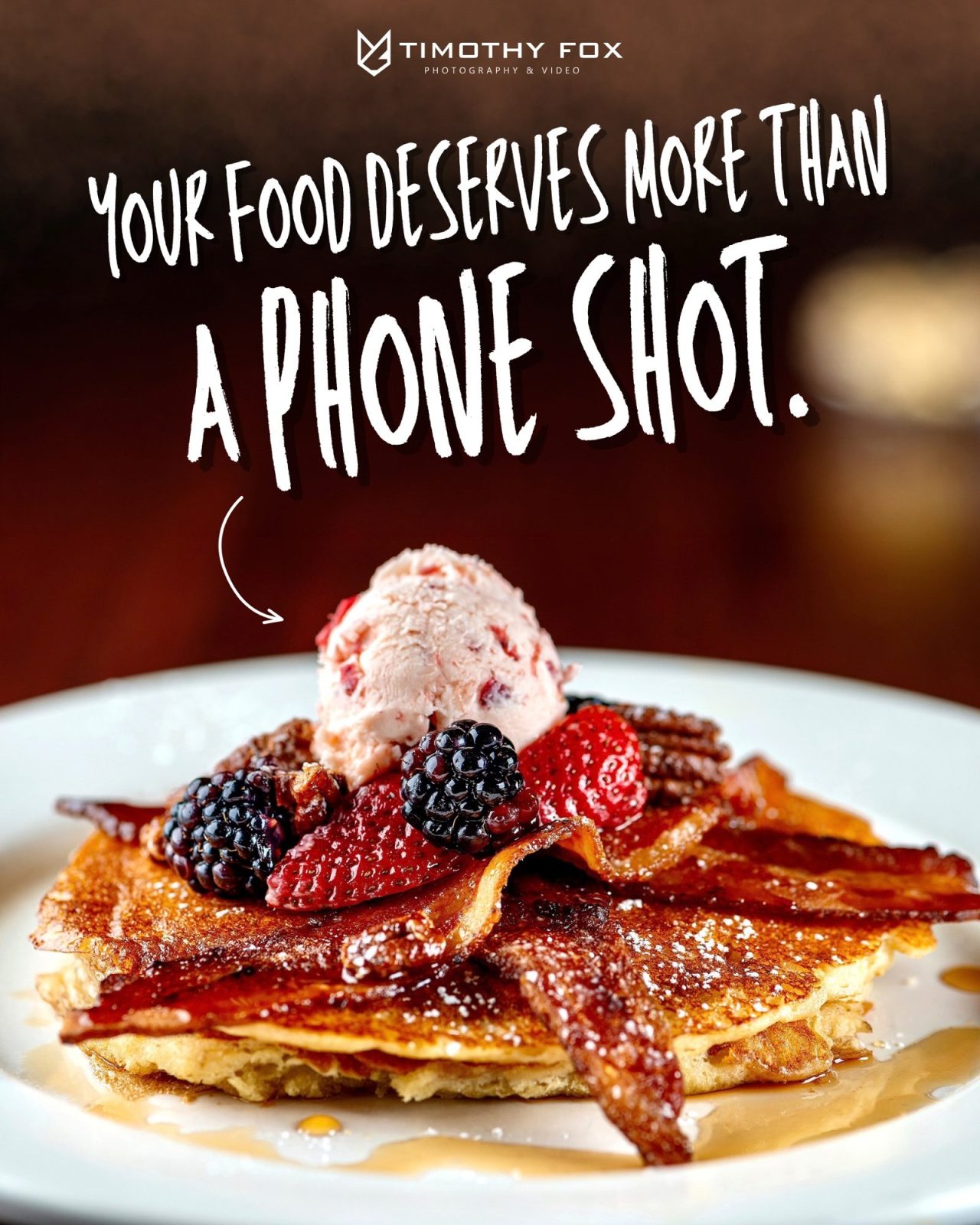
Phone photos are fine for a quick story, but they are the wrong tool for the images that sell your food: your menu, your website, your delivery listings and your Google profile. A phone shot taken under dining room light flattens texture, shifts color and bends the plate, and a hungry customer scrolling past has no way of knowing the dish is better than the picture. You put care into every plate that leaves your kitchen. Your photos should show it.
Why phone food photos let good dishes down
Modern phones take remarkable pictures of people, sunsets and pets. Food is harder, and a restaurant is one of the toughest places to photograph it. Here is where a phone shot usually goes wrong.
The light is wrong. Most dining rooms are lit for mood, not for cameras. Warm bulbs overhead, a window on one side and cooler light spilling from the kitchen all land on the same plate, and the phone tries to average them out. White plates turn yellow or gray, greens go muddy, and a sauce that is glossy in person looks flat and dull.
The lens bends the plate. A phone's main camera is a wide angle. Hold it close enough to fill the frame and the nearest edge of the dish swells while the back shrinks, round plates turn into ovals, and the glass beside them starts to lean.
The phone edits for you. Every frame is processed automatically. The phone brightens shadows, sharpens edges and smooths away whatever it reads as noise. On food, that noise is often the texture you want people to see: the crust on a sear, the crumb of fresh bread, the sugar on a stack of pancakes. Portrait mode brings its own problems, cutting a ragged edge around garnishes, steam and glassware.
It gets shot in a hurry. The photo usually happens mid-service, on the pass, seconds before the plate goes out. Nobody wipes the rim, the herbs have started to wilt, and anything cold is already melting.
Nothing matches. Taken on different days, in different rooms, on different phones, a menu's worth of photos ends up in a dozen different colors. Side by side on a website or a delivery app, it reads as a patchwork rather than a menu.
Where your food photos actually do their work
Most diners have already decided where to eat before they arrive. They look at your Google profile, scroll your website menu, check your Instagram, or open a delivery app and compare you with every other place nearby serving the same kind of food. In each of those places the photo is doing the selling before anyone reads a description.
On a delivery app that photo is a small square sitting next to your competitors' dishes. The plate that looks freshest and most generous at that size gets the tap. On a printed menu, a window poster or a screen in the dining room, the same image is enlarged, and a file that looked sharp on a phone screen can turn soft and blotchy once it is blown up.
When a phone photo is fine
We are not telling you to put the phone away. For stories, today's special, a peek behind the line on a busy Friday, or the team celebrating a good night, speed and personality matter more than polish. Those posts are meant to feel quick, and most of them are gone in a day.
The problem is when the quick shot becomes the permanent one. The picture someone took on the pass two years ago is still the hero image on the website, still on the delivery listing, still the first thing people see on Google. That is the photo doing the most work for your business, and it deserves more than a phone shot.
What a professional food shoot changes
Our job on a food shoot is to make each dish look like the best version of itself that your kitchen can actually reproduce. Nothing fake, nothing a guest will be disappointed by when the real plate arrives.
The plating, props and surfaces are planned before the first dish leaves the kitchen. We build a running order with the kitchen so hot food comes out first and anything that wilts or melts is timed to the minute. We shoot to a consistent setup, so the twelfth plate still matches the first, which matters a great deal once the images sit side by side on a menu page or a delivery app. Styling, retouching and post-production are handled in house as part of the shoot.
We work on location at your restaurant, usually before service or between rushes when the kitchen has room to plate for camera, and we stay out of the line. Edited, high resolution images are usually with you within a few days. If you want something for the feed between menu refreshes, short-form video of pours, prep and plated dishes can be added to the same visit.
Look at the plate at the top of this post
That stack of pancakes, with bacon, blackberries, strawberries, pecans, a dusting of powdered sugar and a scoop on top, is a good example of what changes. The light comes from behind and to the side, so the syrup shines and every grain of sugar catches it. The background falls away into soft, dark color, so nothing competes with the dish. The camera sits low, close to table height, so the stack looks tall and generous instead of flattened from above.
Shot on a phone from across the table under the dining room lights, the same plate would still taste just as good. It just would not look like it.
Ready to retire the phone shots?
If your menu, website or delivery listings are still running on phone photos, that is one of the easiest upgrades on the list. Take a look at our food photography in Phoenix, then message us to talk about your next shoot. We are based in Phoenix and available throughout Arizona.